Home / Permits / Pinellas County
Do I need a permit in Pinellas County? 2026 homeowner guide
Updated September 21, 2026
Probably yes. Pinellas County requires a permit to build, add on, remodel, or tear down at any price, and for any repair over $500.1 Work on wiring, pipes, heat and A/C, gas, or anything that holds the house up needs one whatever it costs, apart from a short list of small jobs in the state code.8 Find your job in the tables below.
Which building department covers your address?
Check this first. Pinellas County has 24 cities, and the answer depends on your address.
Pinellas County covers you if your home is outside city limits, or in Belleair Beach, Belleair Shore, Indian Rocks Beach, Kenneth City, Oldsmar, or Safety Harbor.3
Your city covers you in St. Petersburg, Clearwater, Largo, Pinellas Park, Dunedin, Gulfport, Seminole, Tarpon Springs, and most other cities. Those run their own building departments. Two out of three people here live in a city, so this is most readers.
Cities read the same state law differently. Some count windows, doors, roofing, siding and soffit as structural, which means no price break on any of them.12 Everything below is the county's rule.
What needs a permit in Pinellas County?
Sort your job into one of two groups. That is the whole rule.
Group 1. Normally needs a permit at any price.
Building something new. Adding on. Remodeling. Tearing something down. Plus work on wiring, pipes, heat and A/C, gas, or anything structural. The state code names a few small jobs that get out of this. They are further down.
Structural means the parts that hold the house up: the foundation, beams, walls that carry weight, and the rafters or trusses. Roofing and outside openings sit right on the line. Your building department decides those.
Group 2. Needs a permit only over $500.
Minor repairs. A repair means fixing something that is already there.
So a $300 remodel needs a permit. A $300 repair may not. But price is only half the test. The repair skips the permit only if it stays off structural work, wiring, pipes, and heat and A/C.
That surprises people, so here are the county's own two sentences. The first lists what always needs a permit and never mentions a price:
Pinellas County requires a permit for any new building, addition, remodeling, or demolition, or work in excess of $500.00 or which would require an inspection.1
The second is the county's short list of work you can skip a permit for. The $500 figure only ever appears next to the word repairs, and it carries the same trade limits:
Minor Repairs: Repairs costing less than $500, as long as they do not involve structural changes, electrical, plumbing, or mechanical work.3
One more trap. The first sentence says a permit is needed over $500 and the second says you can skip it under $500. A job that costs exactly $500 falls in the gap. Treat it as needing one.
Florida's own no-permit list is short. It names 12 jobs. Every one of them is a gas, heating, or plumbing item.8 There is no building category and no electrical category at all.
The state code has one more door. A building official can okay an ordinary minor repair with no permit. That door is narrow. It shuts on cutting a wall or a beam. It shuts on pipes, gas, wiring, and A/C gear too.8 So in those five trades, those 12 jobs are still the only ones that skip a permit at any price. The useful ones are in the first table.
| Job | Permit? | What to know |
|---|---|---|
| Painting, wallpaper, trim | No | These three are the only cosmetic jobs the county puts in writing.3 |
| Minor repair under $500 | Usually no | Price is only half the test. Touch anything structural, or wiring, pipes, or A/C, and it needs one at fifty dollars.3 |
| Unclog a drain or fix a drip | No | One of the 12. Once a pipe, valve, or faucet has to be replaced, state code calls that new work.8 |
| New floors, carpet, or tile | Probably no | Nobody printed a flooring rule either way. This is our read of what is missing, so call before a big job.38 |
| Cabinets in the same spot | Probably no | Also our read, not a printed rule. Move a pipe or a wire to fit them and that part needs one.38 |
| Small shed | Often no | Under 100 square feet, no taller than 10 feet, nothing hooked up. All three. Keep it 3 feet off the line. At exactly 100 square feet, ask.11 |
| Fence 6 feet or under | No | A corner lot needs a zoning clearance, and a lot in a flood area needs a Floodplain Permit, at any height.4 |
| Portable cooling unit | No | One of the 12, and the word is portable. A unit that gets wired in or built into a wall is a different job.8 |
| Job | Permit? | What to know |
|---|---|---|
| Roof: new, replaced, or repaired | Normally yes | The county lists roofs as work that might skip the permit under $7,500, then says structural work never can. It has not said which a roof is. Ask before you start.29 |
| Windows | Normally yes | The county treats windows as permit work, and its own form makes a new window meet today's code. Windows are not on the county's under-$7,500 list. Some cities call them structural. The county has never said if a window job can use that break, so ask first.31219 |
| Outside doors and garage doors | Normally yes | The county names doors and garage doors as work that might skip the permit under $7,500. Ask first.214 |
| Inside doors | Ask first | The county has never said either way, and its door form only fits outside openings.14 |
| Water heater | Yes | The same kind in the same spot still needs one. Going tankless adds a peak demand worksheet.14 |
| A/C or heat | Yes | A same-size swap still needs one. Bring the unit specs and signed energy forms with the sizing math.15 |
| Panel, wiring, or new outlets | Yes | You may pull it for your own home. Anyone you hire to do wiring has to be licensed.5 |
| New or moved pipes, repipe | Yes | Call the second rough check before the tub goes in, while the inspector can still reach the pipes.14 |
| Gas line or gas hookup | Yes | When one appliance is added, your contractor signs a county paper saying the leak test passed.14 |
| Bathroom or kitchen remodel | Yes | With more than one trade on the job you file a form naming them all, signed by the contractor.15 |
| Room addition, garage, enclosed porch | Yes | Your property survey has to be under five years old, or the county rejects it.15 |
| Siding, soffit, fascia, stucco | Normally yes | Also on the county's list of work that might skip the permit under $7,500, though some cities call it structural.216 |
| Solar panels | Yes | Redoing a roof that already has panels is two permits, not one.5 |
| Whole-house generator | Yes | Electric work, plus gas work if it runs on gas. Neither gets a price break.2 |
| Pool or spa | Yes | To pass the last check, a new pool needs one safety feature the state approves. A barrier at least 4 feet high, a safety cover, exit alarms, self-closing doors, or a pool alarm.1517 |
| Deck, carport, screen room | Yes | Anything that holds weight needs plans stamped by an engineer. Check your setback first.7 |
| Shed over 100 square feet | Yes | The county's words are less than 100 exempt, larger than 100 a permit. At exactly 100, ask.11 |
| Fence or wall over 6 feet | Yes | On a corner lot you need a zoning OK at any height.4 |
| Retaining wall or seawall over 2 feet | Yes | The line here is 2 feet, not the 6 feet a fence gets.4 |
| Driveway: new, wider, or replaced | Yes, three OKs | A zoning OK, a tree OK, and a road OK. The end of a driveway sits on county land.5 |
| Patio or walkway pavers | Zoning only | Add the road OK only if part of the job runs toward the street.5 |
| Tearing down a building | Yes | If the building was ever a business, daycare, or church, someone licensed checks it for asbestos first.18 |
Two things change the answer on any job. Cutting a new opening in a wall needs a permit, and so does making an existing one wider. So does any work on a wall that carries weight.
Do I need a permit in a flood zone?
Yes, and you may need a second one. Pinellas County calls it a Floodplain Permit. It is a separate approval from the building permit.
County law requires it for work in a high-risk flood area "including buildings, structures and facilities exempt from the Florida Building Code."10 So a job that skips the building permit does not skip this one. A fence 6 feet or under is the clearest case: no building permit, but a Floodplain Permit before you install or replace it.4
Look up your address on the county flood map before you plan around any of this.
What is the new $7,500 permit exemption?
A state law that started July 1, 2026. A job worth less than $7,500 on a single-family house can sometimes skip the building permit. It never covers wiring, pipes, heat and A/C, gas, or structural work, and it never works in a flood area.6
Pinellas names doors, garage doors, roofs, siding, soffit, fascia and stucco as work that might qualify. Those are examples, not the whole list. A job the county never named is not automatically out. The same page says structural work never qualifies, and it has not said where roofing falls.2
It is not yours to decide. You have to ask in writing and get a written yes before anyone starts, and the county's form makes you swear, under penalty of perjury, that you are not in a flood area.13 The work gets no building permit and no county inspection, so keep the stamped approval as your paperwork.2
How much does a building permit cost in Pinellas County?
Most small jobs run $85 to $340. Pinellas County sets a flat fee for the common jobs and charges by value for the rest. The numbers below are the county's own, from its published fee schedule.20
| Job | County fee | What to know |
|---|---|---|
| Water heater swap, same spot | $85 | Moving it, or going tankless, is $200.20 |
| A/C swap | $140 | $240 if the electric is redone too. $340 with new ducts as well.20 |
| Re-roof | $180 | Covers the first 20 squares. Each square after that adds $1.50. A metal roof-over starts at $235.20 |
| Windows, doors, shutters, garage doors | $145 | Covers up to 20 openings. Each extra opening is $5. Electric shutters add $100.20 |
| Electrical panel change | $135 | The county calls it a residential service change.20 |
| Whole-house repipe | $125 | One inspection.20 |
| Siding, soffit, fascia, stucco | $135 | Vinyl siding, soffit and fascia, or stucco over frame.20 |
| Whole-house generator | $300 | Includes every trade and the plan review.20 |
| Pool or spa with deck | $550 | Up to $40,000 of value. Add $5.50 per $1,000 above that.20 |
| Prefab shed over 100 square feet | $175 | A shed framed on site is $375.20 |
| Tearing down a house | $225 | Residential demolition.20 |
| Remodel, addition, or new house | $11 per $1,000 | Based on the value of the work, up to $600,000. At least $100 per inspection, plus a $125 minimum for plan review.20 |
Every permit also carries a state surcharge of 2.5 percent, or $4 at the least, and a technology fee of $3 to $15.20 An after-the-fact permit costs double. More on that below.
These are the county's FY25 numbers, in force since October 1, 2024. The county says it changed its inspection fees on July 1, 2026, so check the fee the Access Portal shows before you pay.3 Cities set their own fees.
How long is a building permit good for in Pinellas County?
Six months. The county's own answer: a permit is valid for six months from the day it is issued, or from the last passed inspection. If the job sits idle for six months, the permit expires.5 That is the state rule too.21
Each passed inspection restarts the clock. To stretch a permit that is about to run out, email the county's Extension/Reinstatement form to permitcloserequest@pinellas.gov with the permit number and the reason.15 Only the building official can grant it.5 Bringing back a permit that already expired is done in the Access Portal under Renew Application, and it costs $125.1520
One more date. Once work has started, or a permit is more than 180 days old, the county gives no refund.20
What happens if you do work without a permit in Pinellas County?
You still have to get the permit, and it costs double. An after-the-fact permit is the county's fix for work done with no permit. It papers the job, gets it inspected, and brings the home back into line.22 The fee is two times the normal permit fee. A licensed contractor who does it again within a year pays ten times.20
Skip that and the county says you can face fines and enforcement. In a flood zone, it can also put the county's 40 percent flood insurance discount at risk.22 A stop-work order costs $200 to lift.20
It follows the house, too. In the county's words, buyers and lenders may require proof that repairs were permitted.22 That is why a permit search before the offer matters. It is the next section.
After Hurricanes Debby, Helene and Milton, the county waived the penalty on after-the-fact storm permits. That waiver ended June 30, 2026.22
How do I look up building permits on a house in Pinellas County?
Search by address on the county's Access Portal. It is free, and you do not need an account.23 Permit records are public, but they are not in one place. Pinellas County keeps records for the homes it covers, and the cities that run their own departments keep theirs. Which office holds your house depends on the address, and older records can sit somewhere else again.
Pinellas County permit search by address, step by step
- Open the Pinellas County Access Portal. Scroll down to the Building section and choose Search Permits.23
- In General Search, type only the street number and the street name. Leave every other box empty.23
- Click Search. If the address has more than one permit, the list sits at the bottom of the page.23
- Open a permit. Under Record Info, pick Processing Status to see where each review stands.23
That search covers unincorporated Pinellas and the six towns the county serves. A home in St. Petersburg, Clearwater, Largo, or any other city with its own building department is in that city's system, not the county's.3
If you would rather have the county pull the file, a permit and property information request is $60 per address.20 Or you can have every office checked at once.
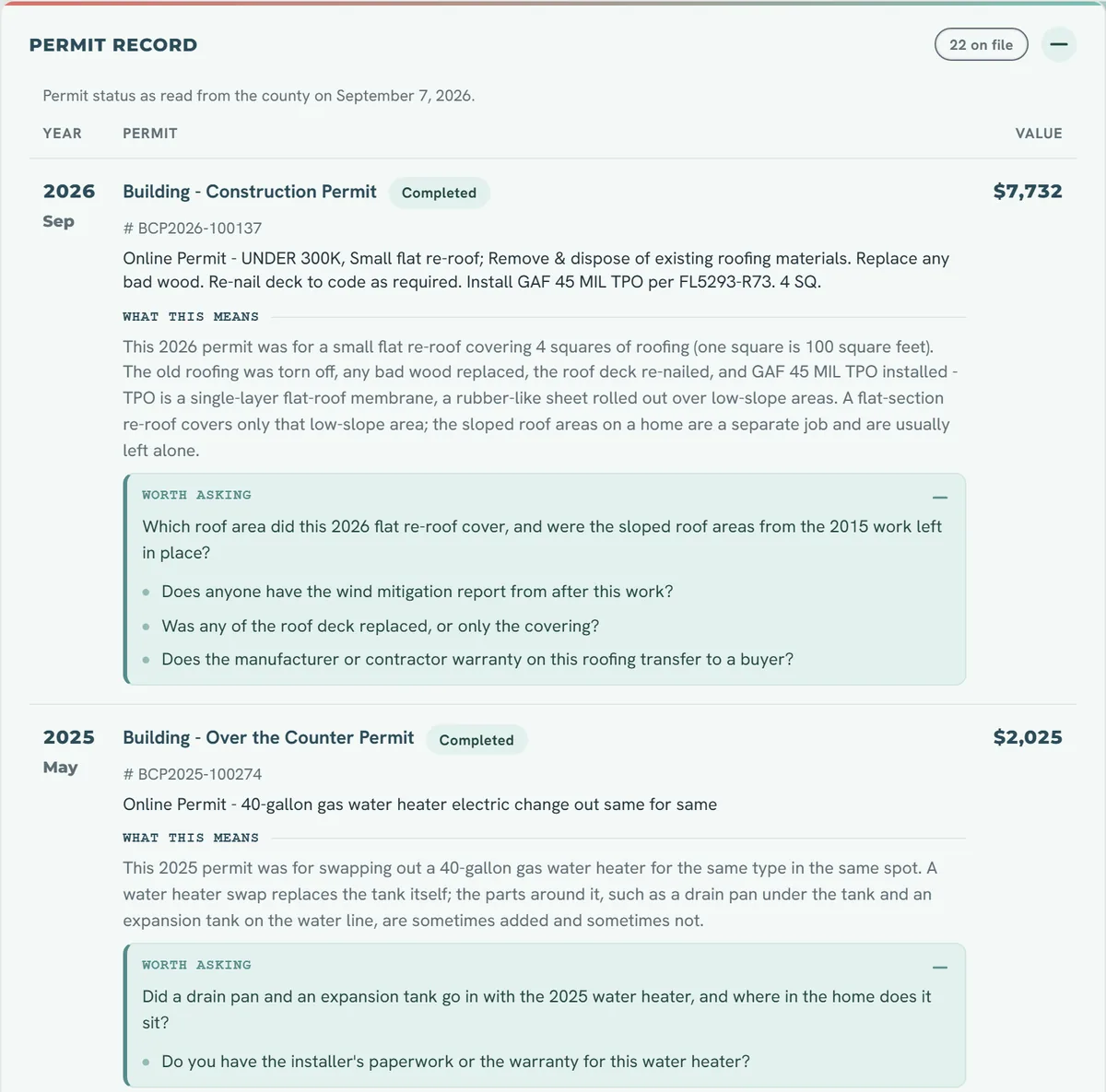
Buying a house? See its permits first.
QReport checks the county and all 24 Pinellas cities for one address. Then it tells you in plain words what work had a permit, when the roof, A/C, water heater and wiring were last done, and if the home sits in a flood zone. We cover ten Florida counties: Pinellas, Hillsborough, Pasco, Manatee, Hernando, Sarasota, Charlotte, Polk, Brevard and Citrus.
See a sample reportWhere these rules come from
- Pinellas County, Permits - the rule about building, adding, remodeling, demolition and the $500 line.
- Permit Exemptions for Work Under $7,500 - projects that "might qualify for this exemption may include minor repairs, construction or replacements of certain, often small structures such as" doors, overhead garage doors, roofs, sidings, soffit/fascia and stucco; the exclusion of structural, gas, electrical, mechanical and plumbing work and flood areas; the written approval, the stamped copy on site, and that exempt work is not inspected.
- Applying for a Building Permit - the towns the county covers, "Repairs costing less than $500, as long as they do not involve structural changes, electrical, plumbing, or mechanical work," the cosmetic list, windows and water heaters as permit jobs, the six towns the county serves, and the notice that the building fee schedule was updated effective July 1, 2026 for inspection and private provider fees.
- Fences and Properties - fences, walls, seawalls, corner lots, and the Floodplain Permit required for a fence at any height in a Special Flood Hazard Area.
- Building FAQ - driveways, pavers, solar on a new roof, pulling your own permit, the rule that hired trade work must be licensed, and "A permit is valid for six months from the date it's issued, or from the last approved inspection date. If the project is dormant for six months, then the permit expires. A permit may be extended only by the building official with a written request."
- Florida Statute 553.79 - it is unlawful to construct, erect, alter, modify, repair or demolish without a permit; and the exemption from a permit for "any work valued at less than $7,500" on a single-family dwelling, which does not apply to a property in a flood hazard area or to electrical, plumbing, structural, mechanical or gas work.
- Residential Permits - pools, decks, sheds, additions, solar, the trade permits, and the rule that structural work needs plans sealed by an engineer or architect.
- Florida Building Code, 8th Edition (2023), sections 105.1, 105.2 and 105.2.2 - the complete no-permit list in 105.2 is 12 items under three headings: Gas, Mechanical and Plumbing. It includes clearing a stoppage, repairing a leak where nothing is replaced, and a portable cooling unit. There is no building category and no electrical category. Section 105.1 names repair as permit work. Section 105.2.2 lets a building official approve "ordinary minor repairs" without a permit, but bars the cutting of any wall or structural beam and bars work on "water supply, sewer, drainage, drain leader, gas, soil, waste, vent or similar piping, electric wiring systems or mechanical equipment."
- Roofing Inspection Policies - every permitted re-roof gets an in-progress inspection, and a signed mitigation affidavit covers anything the inspector can no longer see.
- Pinellas County Land Development Code chapter 158, section 158-61 - a Floodplain Permit is required for development activity in a flood hazard area, "including buildings, structures and facilities exempt from the Florida Building Code."
- Code Enforcement - sheds "less than 100 square feet and no taller than 10 feet" are exempt unless connected to utilities, sheds "larger than 100 square feet" require permits, and the 3-foot setback.
- City of Gulfport and City of St. Petersburg - two Pinellas cities that count windows, doors, roofing, soffit, fascia and siding as structural work.
- Pinellas County, Building Permit Exemption Request Form (Rev 6/2026) - the form you sign under penalty of perjury about the flood area.
- Pinellas County Express Permits and the county's permit forms - the "Windows, Doors" and "Garage Door" permit types; the Window/Door Replacement Permit Form, which asks for a Florida Product Approval number, a wind pressure in pounds per square foot, an exposure category set by distance from open water, and a layout diagram; the second rough-in plumbing request made before a tub is installed; the fuel gas leak test certification; and the tankless water heater peak demand worksheet.
- Pinellas County Permitting Guide - a boundary survey issued within the last five years, the sub-contractor form for multi-trade work, the flood zone application for new construction in A and V zones, signed energy forms with HVAC sizing calculations, the pool Safety Act letter, the utility no-objection letter, the Extension/Reinstatement form emailed to permitcloserequest@pinellas.gov for a permit about to expire, and Renew Application in the Access Portal for one that already has.
- Pinellas County Product Approval Schedule - siding and soffits are listed products, and the form warns that work "may have to be removed if approval cannot be demonstrated during inspection."
- Florida Statute 515.27 and 515.29, the Residential Swimming Pool Safety Act - a residential pool must meet at least one of five safety features: a barrier, an approved safety pool cover, exit alarms on doors and windows, a self-closing self-latching device, or an approved swimming pool alarm. A barrier "must be at least 4 feet high on the outside."
- Pinellas County asbestos NESHAP exemption guide - a single residential building can be exempt from the asbestos survey, but any past commercial, government, daycare, home-business, church or charitable use requires a written survey first.
- Pinellas County Opening Protection Exception Form and Florida Existing Building Code 707.4 - a replacement window "shall be designed and constructed to comply with Chapter 16 of the Florida Building Code-Building," with no count or area below which a replacement escapes.
- Pinellas County FY25 User Fees Schedule, Building and Development Review Services section (effective October 1, 2024) - the minimum of $100 per trade inspection and $125 for plan review; combination permits at $11 per $1,000 of value up to $600,000; the flat fees for a reroof ($180 for the first 20 squares plus $1.50 a square, $235 for a metal roof-over), windows, doors, shutters and garage doors ($145 per 20 openings, $5 each after, $100 more for electric shutters), water heater change-out ($85) or relocation and tankless ($200), A/C change-out ($140, $240 with electric, $340 with ducts), residential service change ($135), repipe ($125), siding, soffit, fascia and stucco ($135), residential generator ($300), pool or spa with deck ($550 up to $40,000 plus $5.50 per $1,000), prefab shed over 100 square feet ($175) or a shed framed on site ($375), and residential demolition ($225); "After-the-Fact" permit fees of two times the normal fee, and ten times for a subsequent one by the same licensed contractor within twelve months; the 2.5 percent state surcharge with a $4 minimum and the $3 to $15 technology fee; the $125 permit reinstatement, the $200 stop work order release, the $60 permit and property information request per address, and no refund once work has commenced or a permit is over 180 days old.
- Florida Building Code, Building, 8th Edition (2023), section 105.4.1 - "Every permit issued shall become invalid unless the work authorized by such permit is commenced within six months after its issuance, or if the work authorized by such permit is suspended or abandoned for a period of six months after the time the work is commenced."
- Pinellas County, After-the-Fact Storm Permitting - "An after-the-fact permit is required when work has already been completed without a permit. It documents the repairs, ensures they meet safety and floodplain standards, and brings the property into compliance"; "Normally, after-the-fact permits cost double"; "Failure to obtain permits can result in fines, enforcement action, and loss of the County's 40 percent discount on National Flood Insurance Program premiums"; "Buyers and lenders may require proof that all repairs were properly permitted"; fines for unpermitted storm work waived through June 30, 2026, with fees reinstated July 1, 2026.
- Pinellas County, Check Building Permit Status Without a Contractor's License - begin on the Access Portal homepage, scroll to the Building section and select Search Permits; in General Search type only the Street Number and Street Name; select Search; if there is more than one permit the list is at the bottom of the page; open a permit and under Record Info select Processing Status.