Home / Permits / Manatee County
Do I need a permit in Manatee County? 2026 homeowner guide
Updated September 22, 2026
Probably yes. Manatee County publishes two lists: the jobs that need a permit and a licensed contractor, and the jobs that need no permit. Watch the second list: a few jobs on it, such as rescreening, still want a licensed contractor.1 Two answers here surprise people. Swapping an electric water heater for the same one, in the same size and the same spot, needs no permit. Nor does an ordinary wood or vinyl fence on a one or two-family lot outside a flood hazard area. Find your job in the tables below.
Which building department covers your address?
Check this first. Manatee County has six cities, and each one runs its own building department.
Your city covers you in Bradenton,2 Palmetto,3 Holmes Beach,4 Bradenton Beach, Anna Maria, or Longboat Key.
Manatee County covers you everywhere else. That is most of the county, including Lakewood Ranch, Parrish, Ellenton, Myakka City and the unincorporated areas around Bradenton. The county's office is Development Services.5
One trap. A city can be stricter than the county on the same job. Holmes Beach puts fences of every kind, drywall and water heaters on its own permit-required list. The county does not.4 Everything below is the county's rule.
What needs a permit in Manatee County?
Manatee prints both halves of the answer in one document: the jobs that need "a State Certified or Locally Licensed Contractor and a Building Permit," and the jobs that "do not require a permit."1 It is the clearest list of any county we cover, and it is also the one with the most exceptions buried in it.
The rule.
Look for your job on the county's no-permit list. If it is not there, expect to need a permit. The county warns its list "does not include all scopes of work that requires/does not require a permit," so call if your job is not clearly on it.1
The one exception.
A state law can excuse some small jobs under $7,500. You have to ask for it in writing first, and roofs, windows, doors and siding never qualify. It is further down this page.
State law sits underneath all of this. It is unlawful to build, alter or repair without a permit unless something excuses you.6 Florida's own no-permit list is short: 12 jobs, every one of them a gas, heating, or plumbing item.7 There is no building category and no electrical category on it at all.
The state code has one more door. A building official can okay an ordinary minor repair with no permit. That door is narrow. It shuts on cutting a wall or a beam. It shuts on pipes, gas, wiring, and A/C gear too.7
| Job | Permit? | What to know |
|---|---|---|
| Electric water heater swap | No | The county's words: electric to electric only, same size, same location. Switch to gas, move it, or go tankless and you need a permit.1 |
| Wood, chain link, or vinyl fence | No | Non-structural fences on a one or two-family lot that is not in a flood hazard area. Masonry walls and columns always need one, and zoning still controls height and placement.1 |
| Painting, wallpaper, pressure cleaning | No | All three are on the county's own list.1 |
| Flooring: tile, carpet, laminate, wood | No | Also trim carpentry, indoor non-structural paneling, shelving and popcorn ceiling removal.1 |
| Cabinet installation | No | Cabinets alone are exempt. A kitchen remodel that adds or alters electrical, plumbing or walls is not.1 |
| Replacing old drywall | No | Only if the job touches no load-bearing wall, no plumbing, electrical or A/C, and the home is not in a flood hazard area.1 |
| Swap a toilet or a faucet | No | As long as no rough plumbing changes. Stopping a leak is exempt too, but replacing the hidden pipe behind it is "new work" and needs a permit.1 |
| Ceiling fan on an existing outlet | No | Plugged in, fine. New wires, or wires joined to existing ones, and it becomes permit work.1 |
| Swap a switch or an outlet | No | Repair or replacement at 20 amps and 120 volts or less. Any other alteration of electrical needs a permit.1 |
| Prefabricated shed, 120 square feet or less | No | And not over 8 feet high at mean roof height. Zoning and flood rules still apply. Manatee's line is not its neighbours' - do not carry another county's number over.1 |
| Detached deck under 30 inches and under 120 square feet | No | Both tests have to pass. Over either one, or attached to the house at all, and it is a permit.1 |
| Rescreening | No | New screen and repairs to hardware or fasteners. The county still wants a licensed contractor. Screening an existing porch or lanai that already has a roof and floor is exempt too - but close any part of the walls with panels, or raise the kick plate over 12 inches, and it needs a permit.1 |
| Window A/C unit, or a portable cooler | No | Also a duct repair, and a coil or compressor replaced by a licensed A/C contractor. A new or replacement system is not.1 |
| Playground gear and paver patios | No | Swings, slides, hoops, and non-structural concrete or paver patios. Setbacks still apply, and running electric to it needs a permit - so does any structural element under it, such as footers or a structural slab.1 |
| Job | Permit? | What to know |
|---|---|---|
| Roof: new or re-roof | Yes | First item on the county's list. The county counts roofing as structural, so the $7,500 break never applies. On a home permitted before the Florida Building Code, tearing the covering off also triggers a check of how the deck is nailed, and a secondary water barrier.18 |
| Windows and doors | Yes | Including cutting a new opening or closing an existing one. Counted as structural, so no price break, and the new window still has to meet today's code.19 |
| Siding, fascia, or soffit | Yes | New or replacement. Also on the county's structural list under the $7,500 law.1 |
| Gas or tankless water heater | Yes | Only the electric-to-electric swap escapes. Gas water heaters, gas pool heaters, gas lines and propane tanks all need permits.1 |
| A/C or heat: new or replaced | Yes | New and replacement air conditioners, new and replacement duct work, range hoods and exhaust fans.1 |
| Panel, service change, or new wiring | Yes | The county's words are "Any alteration of electrical" Residential low voltage is exempt unless it exceeds $5,000 in any 12-month period, so exactly $5,000 is still inside it. The county's own no-permit line covers single-family homes, duplexes and townhouses, not condos.1 |
| Re-pipe, new water service, new sewer | Yes | Also a backflow device, new or replacement.1 |
| Kitchen or bathroom remodel | Depends | The county's test is what the job touches. Cabinets, tile and paint alone need no permit. Add or alter electrical, plumbing or walls and it does.1 |
| Shed over 120 square feet or over 8 feet | Yes | Over either line, or built on site rather than prefabricated, is a permit.1 |
| Masonry fence, wall, or columns | Yes | Brick, block or concrete pulls a fence out of the exemption, residential or commercial.1 |
| Carport, porch, or screen room | Yes | New ones need a permit. Screening an existing porch or lanai that already has a roof and a floor does not - but close any part of the walls with panels, or raise the kick plate over 12 inches, and it does.1 |
| Pool or spa, above ground over 24 inches | Yes | An above-ground pool under 24 inches high is the one that escapes. To pass the last check, a new pool needs one safety feature the state approves: a barrier at least 4 feet high, a safety cover, exit alarms, self-closing doors, or a pool alarm. The county also sets pool and cage setbacks at 5 feet from side and rear lines.1105 |
| Room addition or new house | Yes | Additions, including to a mobile home, and any renovation of an existing structure.1 |
| Spray foam insulation | Yes | The county requires an alteration permit before any spray foam goes in, residential or commercial. Ordinary non-foam insulation needs none.51 |
| Anything structural | Yes | Load-bearing walls, beams, ramps and elevated walkways, a concrete slab with footers, and replacing rotten wood that carries weight.16 |
Two things change the answer on any job. Cutting a new opening in a wall needs a permit, and so does making an existing one wider. So does any work on a wall that carries weight.
What is the $7,500 permit exemption?
A state law that started July 1, 2026. Non-structural work worth less than $7,500 on a single-family home can sometimes skip the building permit. Manatee County publishes the rule on the same page as its permit lists.1
It is not yours to decide. You or your contractor send a written request to the county with a copy of the contract, or other paperwork showing what the work is.1
Four things switch it off. The work is worth $7,500 or more. The property is partly or wholly in a flood hazard area. The job touches electrical, plumbing, mechanical or gas work.16 Or the job is structural, and Manatee is strict about what that means: railings, guards, pool barriers and fences, windows and doors, siding and soffits, roofing and elevated decks are all on its structural list. So a re-roof or a window job never qualifies, whatever it costs.1 You also cannot split a job into pieces to get each piece under $7,500.1
Two things to know before you use it.
The county will not inspect the work. Its words: work done under an approved exemption "will not be inspected by County staff," and the owner and contractor are responsible for meeting the building standards anyway.1
And the approved paperwork has to stay on site. A stamped copy of the exemption request must be there for the whole job, or the county can issue a stop work order.1
What changes if my home is in a flood hazard area?
The $7,500 break is gone. The state law switches that exemption off for a property partly or wholly in a flood hazard area, and the county's own list says the same thing.16 A flood hazard area also takes drywall replacement off the no-permit list and takes an ordinary wood or vinyl fence off it.1
Manatee uses the federal 50 percent rule. If storm repairs or improvements reach half of what the building itself is worth, the county treats the home as substantially damaged or improved and it has to be brought up to today's flood rules, which can mean raising it. The county values the structure from the Property Appraiser's figure for the building alone, without the land, fences or detached structures.11
Look up your address on the county's flood map before you plan around any of this. The county's own reading of it: a zone starting with A or V is high risk and flood insurance is typically required, X5 is moderate risk and X is low risk.11
Can I pull my own permit in Manatee County?
Yes, for the home you live in. Florida lets an owner pull a permit for their own property.12 Manatee prints the condition on its own permit list: an owner can act as the contractor if the home is for their own use or occupancy, and it may not be built or substantially improved for sale or lease.1
There is a catch worth knowing before you start. If the home is sold or leased within one year of finishing, the law presumes you built it to sell or lease, which is what the exemption is not for.112
Either way, if you are fixing a house up to flip it, this is not your exemption.
How much does a building permit cost in Manatee County?
Most small jobs are $48 to $210. Manatee charges one flat fee per permit type, under a schedule that has been in force since April 1, 2023, and it is due in full when you apply.13 It is also the only county around here that knocks money off for a virtual inspection: an A/C change-out, a re-roof, a plumbing job or a siding job all cost less if the inspector can do it by video.13
| Job | County fee | What to know |
|---|---|---|
| A/C change-out | $62, or $48 | $48 with a virtual inspection, $62 without.13 |
| Re-roof | $153, or $118 | $118 with a virtual inspection. Shingle, metal, TPO, tile or wood shake.13 |
| Plumbing: re-pipe, gas water heater, backflow | $62, or $48 | $48 with a virtual inspection. A tankless system is $91.13 |
| Siding, fascia, soffit, or stucco | $96, or $74 | $74 with a virtual inspection.13 |
| Panel, wiring, or service change | $133 | One flat residential electrical fee.13 |
| Windows, doors, shutters, garage door | $128 | Replacement, size for size.13 |
| Solar panels | $127 | One flat fee.13 |
| Whole-house generator | $190 | One flat fee. A gas or LP tank permit is $62.13 |
| Screen room, lanai, or pool cage | $210 | The county's aluminum structure permit.13 |
| Deck | $173 | For a deck over 30 inches or over 120 square feet.13 |
| Prefabricated shed | $91 | A barn, carport, garage or gazebo is 33 cents a square foot instead.13 |
| Fence | $62, or $207 | $62 for a residential non-structural fence, $207 if it is structural.13 |
| Pool or spa | $244 | An above-ground pool or spa is $100.13 |
| Tearing down a house | $140 | Primary or accessory structure.13 |
| Remodel or addition | $300 and up | $300 covers up to 650 square feet, then 27 cents per extra square foot. A new house is 27 cents a square foot.13 |
A state fee of 2.5 percent is added to every permit, at least $4.13 A failed inspection costs $73 to redo.13 Starting work before the permit is issued doubles the fee. More on that below. The county also discounts the fee when a private provider does the plan review or the inspections, and takes 10 percent off a certified green build.1314 The six cities set their own fees.
How long is a building permit good for in Manatee County?
180 days, and every passed inspection restarts it. The county's words: permits expire after 180 days if no required inspection has been approved.5
New houses got longer in 2026. A building permit for a single-family dwelling issued on or after July 1, 2026 no longer expires at 180 days. It now runs a year from issue, or until the next edition of the Florida Building Code takes effect, whichever is later.15
Ask for an extension before the permit expires, through the county's online portal.5 It costs $50 once the permit has been issued, or $15 while it is still an application, and bringing an expired permit back costs $14.13 If a permit goes null and void and no new one is taken out within 180 days, the county can require the work to be removed from the site.5
What happens if you do work without a permit in Manatee County?
The permit costs double. The county's fee schedule prices work commencing before permit issuance at two times the permit fee.13 Getting a stop work order lifted is another $73, and moving into a house with no certificate of occupancy costs $193.13
There is a worse version. If a permit has expired and no new one is taken out within 180 days, the county says the building official can require the work already done to be removed from the site.5
Buyers, this is the part that matters to you. The record follows the house, not the person who built it. A permit search shows which jobs had a permit. Hold that list up against the house, and a new roof or an added room with nothing on file stands out. That search is the next section.
How do I look up building permits on a house in Manatee County?
Search by address on the county's online portal. It is free, and you do not need an account. The county's own instruction is that you can check a permit "using your address, permit number or parcel ID," any time of day.16 Permit records are public, but they are not in one place: the county keeps its own, and each of the six cities keeps theirs.234
Manatee County permit search by address, step by step
- Open Manatee County's Accela Online Services on the Building tab and choose Search Applications.17
- Under Search for Records, use General Search. Type the street number and the street name of the property. Leave the other boxes empty.17
- Click Search. The county's permits for that address list below, newest first, with the status and a plain description of each job.17
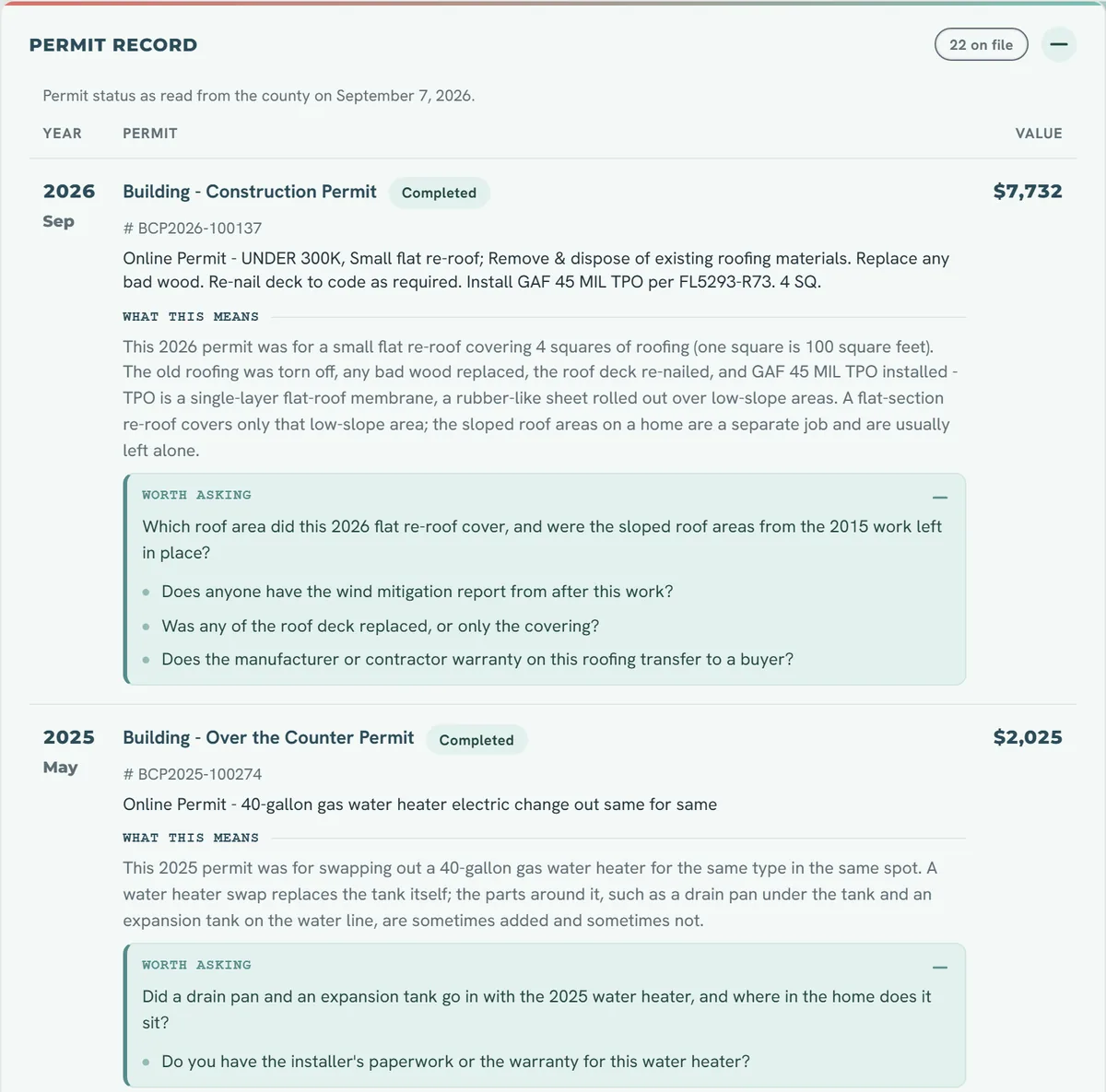
What the list looks like. Manatee numbers its permits with the year and month inside, so BLD2406-1389 is a June 2024 record. On the two homes we searched on September 22, 2026, the address search returned 8 records each, one set reaching back to March 2018.17 The county publishes no cut-off date for what is online, so treat a missing job as a question rather than an answer: ask the county for the record through its public records request.18 A home in one of the six cities is in that city's system, not the county's.
That is the part that stops people. You can call the office that covers your address and ask for the permit history. The county's number is 941-748-4501, extension 3800.5 Or you can have every office checked at once.
Buying a house? See its permits first.
QReport checks the Manatee County permit office and, if the address is inside a city, that city's too. Then it tells you in plain words what work had a permit, when the roof, A/C, water heater and wiring were last done, and if the home sits in a flood zone. All six Manatee cities are covered, and we cover seven Florida counties: Manatee, Pinellas, Hillsborough, Pasco, Hernando, Sarasota and Charlotte.
See a sample reportWhere these rules come from
- Manatee County Development Services, What does and does not require a permit, updated June 16, 2026, linked from the county's Permitting Section page - the permit-required list ("New Roofs and re-roofs"; "Windows & Doors (Includes new openings and closing of existing opening)"; "Attached Decks 120 sq.ft. or larger and 30" or higher"; "Ramps and elevated walkways"; "New/Replacement of siding."; "Kitchen remodel (only if adding or altering existing electrical, plumbing, building, or walls)"; "Renovation of existing structures"; "Masonry fences/walls and columns (Residential and Commercial)"; "Replacement/Repair of rotten wood (only if load bearing or structurally significant)"; "New/Replacement of fascia and soffits."; "Ceiling fans (If new wires are installed or wires are connected to existing wires)"; "Additions (including mobile homes)"; "New carport, porch, and screen room (No permit required on screening of existing porch or lanai with existing roof and floor/slab). If any portion of the walls are closed in with panels, etc. or kick plate is higher than 12 inches will require a permit."; "Sheds (includes prefabricated)"; "Concrete slab with footers"; "Swimming pools (including above ground pools that exceed 24" inches in height)"; "Foam Insulation on Residential structures"; "Any alteration of electrical"; "Residential low voltage (wired or wireless) (No permit required unless cost exceeds $5000 within any 12-month period)"; "Service Changes"; "Replacement and New Air Conditioners"; "Replacement and New Install Duct Work"; "Range Hoods"; "Replacement and New Exhaust Fans"; "Natural Gas Line install"; "Propane Tank install"; "Natural Gas/Propane Gas Water Heater Install"; "Tankless water heater replacement/new install"; "Backflow replacement/new install"; "Re-pipe"; "New water service"; "New sewer/replacement"); the no-permit list ("Painting"; "Wallpaper and other wall coverings"; "Rescreening, any repairs of hardware or fasteners but requires a license."; "Pressure cleaning"; "Trim carpentry"; "Flooring (tile, carpet, laminate, wood, etc.)"; "Paneling (Indoor nonstructural)"; "Shelving"; "Popcorn ceilings (remove and refinish)"; "Cabinet installation"; "Ceiling fans (if plugged into an existing electrical outlet)"; "Replacement of old drywall to new (Installation or replacement of drywall if the contract does not include work on load bearing walls, structures within flood hazard areas or any plumbing, electrical, or air conditioning work.)"; "Non foam Insulation on residential."; "Non-Structural residential fences, such as wood, chain link and vinyl are exempt from obtaining a building permit when located on a one or two-family lot that is not located in a flood hazard area."; "Prefabricated sheds used as tool and storage, playhouses and similar uses provided the floor area does not exceed 120 square feet and not over 8 feet high, calculated from mean roof height, however zoning and flood regulations will still apply."; the playground-equipment entry, which exempts residential swings, slides, monkey bars, basketball hoops, doghouses and pump covers but still requires zoning setbacks and a permit for "Any electric service to such playground equipment or any structural element such as footers/structural slabs"; "Detached Decks that are under 30 inches in height and under 120 square foot in size."; "Non-structural concrete/paver patio"; "Repair or replacement of electrical wall switches and wall outlet devices (receptacles) 20 amps and 120 volts or less."; "Replacement of window air conditioning unit"; "Portable cooling unit"; "Repair of residential air conditioning duct"; "Repair/replacement of residential coil, compressor or refrigerant piping by licensed air conditioning or mechanical contractor"; "Replacement of plumbing fixtures such as toilets and faucets providing no rough plumbing has been changed"; "Water heaters change out - electric to electric ONLY, same size, same location (commercial and residential)"; the stopping-of-leaks entry, which exempts stopping a leak but provides that where a concealed pipe "becomes defective and it becomes necessary to remove and replace the same with new material, such work shall be considered new work and a permit shall be obtained"); the disclaimer that the document "does not include all scopes of work that requires/does not require a permit"; the owner-builder note ("An owner can serve as a contractor providing the building or residence is for their own use or occupancy. It may not be built or substantially improved for sale or lease. If a building or residence that has been built or substantially improved by an owner is sold or leased within 1 year after the construction is complete, the law will presume that the owner built or substantially improved it for sale or lease, which violates this exemption."); and the HB 803 section ("certain non-structural residential construction projects with a total value of less than $7,500 may qualify for a permit exemption. However, the exemption does not apply to: Electrical work / Plumbing work / Mechanical work / Gas work / Structural work including (Railings, guards, pool barrier/fences, windows and doors, siding and soffits, roofing, elevated decks are all items with structural requirements and considered structural) / Any work on a property located partially or entirely within a flood hazard area"; "State law also prohibits dividing a larger project into multiple smaller projects to avoid permitting requirements."; the written request "with a copy of the contract or other documentation demonstrating the nature of the work to be performed"; "a copy of the exemption request stamped and approved by the Building Official must remain on-site throughout construction and be available for review by Code Enforcement personnel"; "Failure to maintain the approved exemption documentation on-site may result in the issuance of a Stop Work Order."; and "Work performed under an approved permit exemption will not be inspected by County staff.").
- City of Bradenton, Building and Permitting Division - the city's own building division at 101 12th Street West, (941) 932-9414, with its own online permitting and its own House Bill 803 exemption page.
- City of Palmetto, Building Department, 601 17th Street West, (941) 721-2166 - "A permit is also required to erect a fence and for other minor construction projects such as storage sheds. If you are not sure whether or not a permit is required, call the Building Department at (941) 721-2166 before you proceed with your improvement."
- City of Holmes Beach Building Department, Do I Need a Permit, 941-708-5833 - the city's own permit-required list, which includes "Fences including masonry and columns," "Drywall," "Water heaters" and "Any alteration of electrical, plumbing, mechanical, or gas." The county's list treats all three of those differently, which is why a city address needs the city's answer.
- Manatee County, Permitting Section - Manatee County Permitting at 941-748-4501 x3800 and permitting@mymanatee.org; "Permits expire after 180 days if no required inspections have been approved. In order for a project to be complete, it must pass final inspection(s), fees paid, and have all conditions met."; "If a new permit is not obtained within 180 days from the date the initial permit became null and void, the building official is authorized to require that any work which has been commenced or completed be removed from the building site."; the three options on expiry, including "Submit application for an extension prior to expiration of your permit through online services"; "Manatee County Development Services requires an alteration permit for all residential and commercial jobs before any spray foam can be applied."; and "Setbacks for swimming pools and screened pool enclosures are five (5) feet from the side and rear property lines, however no pool or pool cage shall encroach in any easements or drainage swales."
- Florida Statute 553.79 - it is unlawful to construct, erect, alter, modify, repair or demolish without a permit; and the exemption from a permit for "any work valued at less than $7,500" on a single-family dwelling, which does not apply to a property in a flood hazard area or to electrical, plumbing, structural, mechanical or gas work.
- Florida Building Code, 8th Edition (2023), sections 105.1, 105.2 and 105.2.2 - the complete no-permit list in 105.2 is 12 items under three headings: Gas, Mechanical and Plumbing. There is no building category and no electrical category. Section 105.1 names repair as permit work. Section 105.2.2 lets a building official approve "ordinary minor repairs" without a permit, but bars the cutting of any wall or structural beam and bars work on "water supply, sewer, drainage, drain leader, gas, soil, waste, vent or similar piping, electric wiring systems or mechanical equipment."
- Florida Statute 553.844(3)(a) - roof-deck re-nailing and a secondary water barrier are required when a roof covering is removed and replaced on a structure not permitted under the Florida Building Code, which is broadly homes built before 2002.
- Florida Existing Building Code, section 707.4 - a replacement window "shall be designed and constructed to comply with Chapter 16 of the Florida Building Code-Building," with no count or area below which a replacement escapes.
- Florida Statute 515.27 and 515.29, the Residential Swimming Pool Safety Act - a residential pool must meet at least one of five safety features: a barrier, an approved safety pool cover, exit alarms on doors and windows, a self-closing self-latching device, or an approved swimming pool alarm. A barrier "must be at least 4 feet high on the outside."
- Manatee County, Floodplain Management Section - "If the flood zone starts with 'A' or 'V', these are the high risk zones and flood insurance is typically required; X5 is considered moderate risk and X low risk and flood insurance is not typically required."; "Substantial Damage Determinations are separate evaluations from storm repairs which are categorized as Substantial Improvements. The 50% rule has two different criteria, and it is possible to be over on one and not the other. All storm related work must be applied for."; "Values are taken from the Property Appraiser's website. This is highlighted as the FEMA Value, which is the cost of the structure minus the land and any features (such as fences, detached structures, etc)."; a private appraisal's "Intended Use must include FEMA 50% Rule" and it "Must use the Actual Cash Value Approach"; and Flood@mymanatee.org.
- Florida Statute 489.103(7) - the owner-builder exemption for a person improving their own property, and its conditions.
- Manatee County Development Services Building Fee Schedule, effective April 1, 2023 (Resolutions 23-043, 23-045, 23-046), linked from Development Services Instructions and Forms - Prefabricated Utility Shed $91; Accessory Structure (barn, carport, garage, gazebo, pergola, utility building) $0.33 per square foot; Aluminum Structure (glass room, lanai, screen enclosures) $210; Concrete $151; Deck, "For Commercial and Residential attached or Commercial and Residential detached that is higher than 30 inches or greater than 120 square feet", $173; Demolition $140; Electrical Express (Residential Only, for alteration, new, renovation, service change) $133; Door Window (exterior door, windows, shutters and garage door replacement, size for size) $128; Fence Commercial or Residential Structural $207 and Fence Residential Nonstructural $62; Generator $190; AC Changeout Express "with No Virtual Inspection" $62 and "with Virtual Inspection" $48; Mechanical Standard $62; Plumbing Express $62 and $48 with a virtual inspection; Plumbing - Tankless System $91; New Residential $0.27 per square foot; Alteration or Addition Residential "$300 minimum fee up to 650 square feet plus $0.27 per additional square foot"; Roof Express $153 and $118 with a virtual inspection; Siding, Fascia, Soffit (and stucco) $96 and $74 with a virtual inspection; Solar $127; Above Ground Pool/Spa $100 and In Ground Pool/Spa $244; Tank for LP gas or gas piping $62; Reinspection "For each failed inspection" $73; Permit Extension "For permit that has been issued" $50; Permit Application Extension "For a permit that has not been issued" $15; Reinstatement of Expired Permit $14; Stop Work Order Release $73; "Residential-Occupying Structure without Certificate of Occupancy or Completion" $193; "Work Commencing Before Permit Issuance / 2 times the permit fee"; "The building permit fee and state fee must be paid in full at the time of permit application."; "All building departments are required to collect a 2.5% fee on all permits. The minimum amount collected on any permit will be $4.00."; and "Green Building 10% permitting fee reduction on new commercial, new residential or major renovations."
- Manatee County Development Services memorandum, Interim Permit Fee Reductions for Private Provider Services, June 25, 2026, under Florida Statute 553.791 - "Single Service: If a fee owner, or the fee owner's contractor, retains a private provider for purposes of plans review or building inspection services, the permit fee is reduced by 25 percent of the portion attributed to that specific service"; "Both Services: ... the permit fee is reduced by 50 percent of the amount otherwise charged for such services."
- Manatee County, Florida House Bill 803 New Single-Family Dwelling Building Permit Expiration Date, published June 30, 2026 - "All new single-family dwelling building permits, that are issued on or after July 1st, 2026, will no longer expire 180-days from the date of issuance. In accordance with Florida House Bill 803, building permits issued for single-family dwellings will now expire 1-year after the issuance of the permit, or on the effective date of the next edition of the Florida Building Code, whichever is later."
- Manatee County, Search Permit Records - "You can easily check your permit's progress and status here using your address, permit number or parcel ID"; the service is listed as available 24/7 to property owners and general contractors, and the link goes to the county's Accela Online Services.
- Manatee County Accela Online Services, Building tab - the county's public permit portal, the same page our own software reads. Observed live on September 22, 2026: Search Applications opens a General Search form taking a street number and street name with no login and no date limit pre-filled, and results list newest first with the record number, type, address, status and a description of the work. Record numbers run BLD plus the year and month plus a serial. Street number 21910 with street name 73RD returned 8 records for that one property, from a June 2024 new single-family permit onward; street number 6804 with CORTEZ returned 8 records running from March 2018 to September 2026.
- Manatee County, Request a Public Record - the county's public records request service, for records an online search does not list.