Home / Permits / Hillsborough County
Do I need a permit in Hillsborough County? 2026 homeowner guide
Updated September 21, 2026
Probably yes. Hillsborough County says most construction needs a permit.2 Unlike some Florida counties, it does not set a dollar line. It publishes a list of the jobs you can skip a permit for.1 If your job is not on that list, it most likely needs a permit. Find your job in the tables below.
Which building department covers your address?
Check this first. Hillsborough County has only three cities, and each one runs its own building department.
Your city covers you in Tampa,5 Temple Terrace,6 or Plant City.7
Hillsborough County covers you everywhere else. That is most of the county, including Brandon, Riverview, Valrico, Carrollwood, Lutz and Apollo Beach. Those places are not cities. They are unincorporated county, and the county is your building office.2
One trap. Your mailing address is not the answer. Plant City warns that you can have a Plant City address and still be in the county.7 Everything below is the county's rule.
What needs a permit in Hillsborough County?
Hillsborough works the opposite way from a county with a price rule. There is no "under this much and you are fine." The county prints a list of exempt work, and its own words for anything else are that it "most likely requires a permit."1
The rule.
If the job is on the county's exempt list, you can skip the permit. If it is not on the list, expect to need one. Cost does not move a job onto the list.
The list is not the whole world. The county says it holds "the most frequently requested categories and types," and tells you to call Development Services when your job is not clearly on it.1
The one exception.
A state law can excuse some small jobs under $7,500. You have to ask for it first. It is further down this page.
State law sits underneath all of this. It is unlawful to build, alter or repair without a permit unless something excuses you.4 Florida's own no-permit list is short: 12 jobs, every one of them a gas, heating, or plumbing item.3 There is no building category and no electrical category on it at all.
The state code has one more door. A building official can okay an ordinary minor repair with no permit. That door is narrow. It shuts on cutting a wall or a beam. It shuts on pipes, gas, wiring, and A/C gear too.3
| Job | Permit? | What to know |
|---|---|---|
| Painting, wallpaper, tile | No | The county prints these as cosmetic work.1 |
| New floors, carpet, or wood | No | Named on the county's own list. Many Florida counties never printed a flooring rule at all.1 |
| Cabinets and shelving | No | Named on the list. But move a pipe or a wire to fit them and that part needs one.1 |
| Shed or greenhouse under 150 square feet | No | Hillsborough's line is 150 square feet. Do not carry a neighboring county's number over.1 |
| Fence of PVC, wood, or chain link | No | For the building permit the test is the material, not the height. Zoning still controls height and placement, and the county says to call zoning about every fence.1 |
| Unclog a drain, stop a leak, reset a toilet | No | The county and the state code agree on these. Replace a hidden pipe and it becomes permit work.13 |
| Clean a septic tank | No | Cleaning only. Replacing the tank or the drainfield is a different job.1 |
| Low-voltage work, $5,000 or less | No | The county's test is labor and materials together not exceeding $5,000, in an existing single-family home. Exactly $5,000 is still inside it.1 |
| Portable heater or cooling unit | No | The word is portable. A unit that gets wired in or built into a wall is a different job.13 |
| Dock the Port Authority already approved | No | The approval has to exist first. No approval, no exemption.1 |
| Job | Permit? | What to know |
|---|---|---|
| Roof: new, replaced, or repaired | Normally yes | The county names non-structural roof work as work that might skip the permit under $7,500. But on a home permitted before the Florida Building Code, tearing the covering off triggers a check of how the deck is fastened, and a secondary water barrier. If the fastening has to be strengthened, that part is structural, and structural work never gets the $7,500 break.110 |
| Windows | Normally yes | The county does name window replacement as possibly exempt under $7,500. Ask first, and know the new window still has to meet today's code either way.111 |
| Outside doors | Normally yes | Also named as possibly exempt under $7,500. Same answer: ask before anyone starts.1 |
| Porch | Yes | The county's words are "all porches require a permit." No size, no price, no exception.1 |
| Concrete or electric fence | Yes | The two fence types the county pulls back out of the exemption. Call zoning either way.1 |
| Shed over 150 square feet | Yes | Over the line is a permit. At exactly 150, ask, because the county's word is "less than."1 |
| Water heater | Yes | No water heater sits on the county's exempt list. The same kind in the same spot still needs one.1 |
| A/C or heat, not portable | Yes | Replacing a fixed system needs a permit, even for the same size. Portable equipment is exempt, and so are a few small mechanical items like a minor replacement part.13 |
| Panel, wiring, or new outlets | Yes | The $5,000 break is for low voltage only. House wiring is not low voltage and gets no price break.1 |
| Replace a hidden pipe or move a fixture | Yes | The county draws its plumbing line here: concealed pipe or a fixture that moves.1 |
| Bathroom or kitchen remodel | Depends | The county says it depends on the work. Tile and cabinets alone likely need no permit. Touch the plumbing, wiring, A/C or anything structural and it does.2 |
| Room addition or new building | Yes | New construction is the plainest case there is.2 |
| Pool or spa | Yes | To pass the last check, a new pool needs one safety feature the state approves. A barrier at least 4 feet high, a safety cover, exit alarms, self-closing doors, or a pool alarm.12 |
| Anything structural | Yes | Beams, load-bearing walls, the foundation, rafters and trusses. Nothing structural gets a price break.14 |
Two things change the answer on any job. Cutting a new opening in a wall needs a permit, and so does making an existing one wider. So does any work on a wall that carries weight.
What is the $7,500 permit exemption?
A state law that started July 1, 2026. Non-structural work worth less than $7,500 on a single-family home can sometimes skip the building permit. Hillsborough names siding, window and door replacement, and non-structural roof work as jobs that might qualify.1
It is not yours to decide. In Hillsborough you apply through the county's HillsGovHub portal and hand over paperwork showing the scope and the value of the work.113
Three things switch it off completely. The work is worth $7,500 or more. The property is in a flood hazard area. Or the job touches electrical, plumbing, structural, mechanical or gas work.14 That last one is why a water heater or a panel never qualifies, whatever it costs.
What changes if my home is in a flood hazard area?
The $7,500 break is gone. The state law switches that exemption off for a property partly or wholly in a flood hazard area, and the county says the same thing.14 The term that matters is flood hazard area, not any flood zone letter on a map.
There is more paperwork too. The county requires a Substantial Improvement Worksheet for all projects inside a Special Flood Hazard Area, or an approved FEMA Elevation Certificate showing the building is high enough.8 Look up your address on the county's flood map before you plan around any of this.8
Can I pull my own permit in Hillsborough County?
Yes, for the home you live in. Florida lets an owner pull a permit for their own property.9 Hillsborough asks that the property be in your name and be your primary residence, and it makes you sign an Owner Builder Disclosure Statement.2
There is a catch worth knowing before you start. Hillsborough tells owner-builders not to sell, lease or rent the property for a year after the work is done.2 The state law behind that is worded differently. Selling or leasing inside that year does not break a ban. It creates a presumption that you built it to sell, which is the thing the owner-builder exemption is not for.9
Either way, if you are fixing a house up to flip it, this is not your exemption.
How much does a building permit cost in Hillsborough County?
Most small jobs are $130 to $250. Hillsborough County charges one flat fee per trade permit, and the whole fee is due when you apply. The numbers below are the county's own, from its fee schedule.14
| Job | County fee | What to know |
|---|---|---|
| A/C swap, like for like | $130 | The county calls it an HVAC equal change out.14 |
| Water heater, repipe, other plumbing | $130 | One flat plumbing fee. Gas work is $130 too.14 |
| Panel, wiring, other electrical | $130 | One flat electrical fee.14 |
| Re-roof | $250 | Any size of house.14 |
| Windows and outside doors | $130 | Covers up to 20 openings, same size as before. A different size is $250.14 |
| Garage door | $130 | Same size. A different size is $250.14 |
| Storm shutters or awning | $160 | One flat fee. |
| Siding, stucco | $190 | Stucco, exterior plaster and siding.14 |
| Whole-house generator | $250 | $320 if it runs on gas.14 |
| Solar panels | $250 | One flat fee. |
| Deck, shed, carport, screen room | $380 | These need plan review, not just inspections.14 |
| Pool or spa | $475 | An above-ground pool is $150.14 |
| Tearing down a house | $190 | Residential demolition.14 |
| Remodel, addition, or new house | $1 per square foot | Under-roof area, all four trades included, $380 at the least. Half is due for plan review and half at issue.14 |
State surcharges are added on top.14 Work done before the permit is charged an extra 100 percent of the fee. More on that below.14 Tampa, Temple Terrace and Plant City set their own fees.
How long is a building permit good for in Hillsborough County?
Six months. Under the Florida Building Code, a permit becomes invalid if the work has not started within six months of issue, or if the work stops for six months once it has begun.15 Each passed inspection restarts that clock.
Hillsborough charges $50 to extend a permit, $50 to extend an application, and $50 to bring back a permit after it has expired.14 Ask before the six months run out. It is cheaper than starting over.
What happens if you do work without a permit in Hillsborough County?
Stop the work, then get an after-the-fact permit. Those are the county's instructions. If a job is under way with no permit, stop right away and email permitting@hcfl.gov to start an after-the-fact permit.2
The fee schedule adds a penalty of 100 percent of the permit fee for work started before the permit.14 Keep working after you are told to stop and the county warns it gets more costly to fix, with a citation of up to $500 per violation.2 A failed inspection costs $125 to redo.14
The record follows the house. A buyer's permit search shows which jobs had a permit. Hold that list up against the house, and a big job with no permit on file stands out. That search is the next section.
How do I look up building permits on a house in Hillsborough County?
Search by address on HillsGovHub. It is free, and you do not need an account.17 Permit records are public, but they are not in one place. The county keeps its records in HillsGovHub, and Tampa, Temple Terrace and Plant City each keep their own.567 And even the county's own records sit in three places, by date.
Hillsborough County permit search by address, step by step
- Open HillsGovHub on the Building tab and choose Search Applications.13
- Under Search for Records, use General Search. Type the street number and the street name of the site address. Leave the other boxes empty.13
- Click Search. Every county permit filed for that address since January 20, 2021 lists below.16
Older permits are somewhere else. The county's own guide splits its records by date. Permits from 2005 to January 19, 2021 live on the Building Permits Reports page. Permits from 1976 to 2004 are not online at all. For those you file a records request with the year the house was built, the address, any old address, and the folio number.16 A home in Tampa, Temple Terrace or Plant City is in that city's system, not the county's.
That is the part that stops people. You can call the office that covers your address and ask for the permit history. The county's number is (813) 272-5600.2 Or you can have every office checked at once.
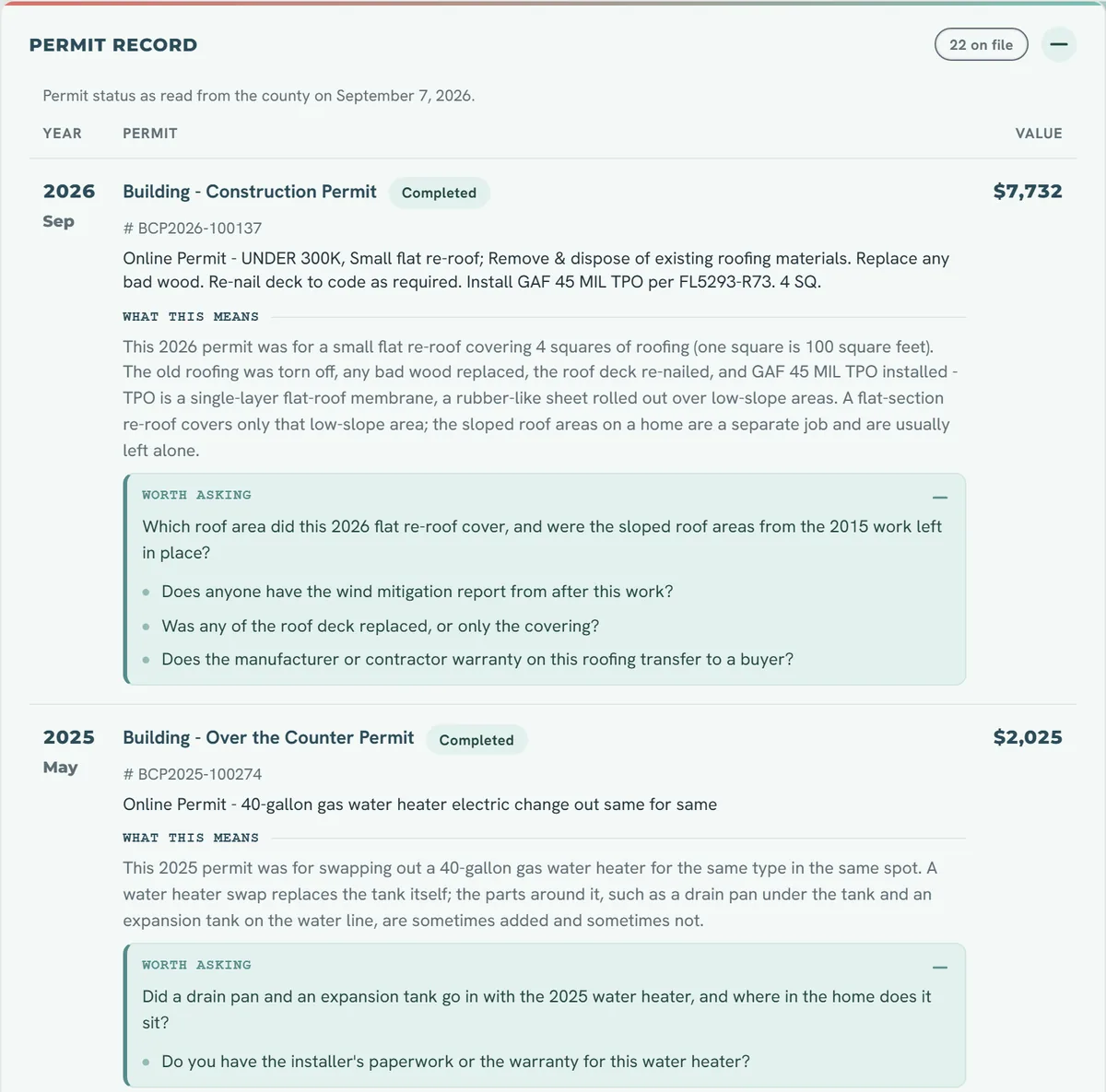
Buying a house? See its permits first.
QReport checks Hillsborough County, Tampa, Temple Terrace and Plant City for one address. Then it tells you in plain words what work had a permit, when the roof, A/C, water heater and wiring were last done, and if the home sits in a flood zone. We cover ten Florida counties: Hillsborough, Pinellas, Pasco, Manatee, Hernando, Sarasota, Charlotte, Polk, Brevard and Citrus.
See a sample reportWhere these rules come from
- Hillsborough County, Work Exempt from Permits - the cosmetic list (painting, tile, floor coverings, shelving, cabinet work, wallpapering), fences of PVC, wood or chain link, "residential sheds and greenhouses less than 150 square feet," docks with Port Authority approval, "all porches require a permit," electrical and concrete fences, low-voltage work under $5,000 in labor and materials, portable heating and cooling, the plumbing line between stopping a leak and replacing concealed pipe, septic tank cleaning, and the HB 803 exemption with its three exclusions and its HillsGovHub application.
- Hillsborough County, Permits for Homeowners - that most construction requires a permit, the bathroom-remodel-with-plumbing example, the owner-builder conditions and the one-year no-sale rule, and Development Services at (813) 272-5600, permitting@hcfl.gov, 601 E. Kennedy Blvd., Tampa. Also the instruction that if work has started without a permit you "stop the work immediately and contact permitting@hcfl.gov for information on how to obtain an After-The-Fact permit," and that not stopping "will be more costly to resolve the problem and you may be issued a citation of up to $500 per violation."
- Florida Building Code, 8th Edition (2023), sections 105.1, 105.2 and 105.2.2 - the complete no-permit list in 105.2 is 12 items under three headings: Gas, Mechanical and Plumbing. There is no building category and no electrical category. Section 105.1 names repair as permit work. Section 105.2.2 lets a building official approve "ordinary minor repairs" without a permit, but bars the cutting of any wall or structural beam and bars work on "water supply, sewer, drainage, drain leader, gas, soil, waste, vent or similar piping, electric wiring systems or mechanical equipment."
- Florida Statute 553.79 - it is unlawful to construct, erect, alter, modify, repair or demolish without a permit; and the exemption from a permit for "any work valued at less than $7,500" on a single-family dwelling, which does not apply to a property in a flood hazard area or to electrical, plumbing, structural, mechanical or gas work.
- City of Tampa, Construction Services - the division that issues every building permit and inspection inside Tampa city limits, at (813) 274-3100.
- City of Temple Terrace, Building Division - permitting, inspections and contractor registration for addresses inside Temple Terrace, with its own portal and fees.
- City of Plant City, Building Division - permits for addresses inside the incorporated city limits, and the warning that a Plant City mailing address does not mean the property is inside them.
- Hillsborough County, Special Flood Hazard Area Requirements - "Substantial Improvement Worksheets are required for all projects within the SFHA," or an approved FEMA Elevation Certificate documenting that the building is properly elevated, plus the county's Find My Flood Zone map.
- Florida Statute 489.103(7) - the owner-builder exemption for a person improving their own property, and its conditions.
- Florida Statute 553.844(3)(a) - roof-deck re-nailing and a secondary water barrier are required when a roof covering is removed and replaced on a structure not permitted under the Florida Building Code, which is broadly homes built before 2002.
- Florida Existing Building Code, section 707.4 - a replacement window "shall be designed and constructed to comply with Chapter 16 of the Florida Building Code-Building," with no count or area below which a replacement escapes.
- Florida Statute 515.27 and 515.29, the Residential Swimming Pool Safety Act - a residential pool must meet at least one of five safety features: a barrier, an approved safety pool cover, exit alarms on doors and windows, a self-closing self-latching device, or an approved swimming pool alarm. A barrier "must be at least 4 feet high on the outside."
- HillsGovHub - the county's online permitting portal, where county permits are applied for, tracked and searched; its Building tab carries Search Applications, and the Search for Records form there takes a site address (street number and street name) in General Search with no login.
- Hillsborough County Building Permit Fee Schedule, effective October 5, 2024, linked from the county's Building Permit Fees page - residential trade permits at $130 for building, mechanical (including an HVAC equal change out), plumbing, gas and electrical, $130 for exterior door and window replacement up to 20 openings and for a garage door ($250 for a different size), $160 for an awning or shutter, $190 for stucco, exterior plaster and siding, $190 for demolition, $250 for roofing, $250 for a generator ($320 with gas) and $250 for photovoltaic; miscellaneous residential permits at $380 for decks, sheds, carports, pool enclosures and screen rooms, $475 for a pool or spa and $150 for an above-ground pool; new construction, additions and alterations at $1.00 per square foot under roof for R-3 residential with a $380 minimum, the fee including building, mechanical, electrical and plumbing, split half plan review and half inspection with a $50 application fee inside it; $50 for a permit extension, a permit application extension and an expired permit reinstatement; $125 for a reinspection; "Work without Permit Penalty shall be charged an additional 100% of permit fee"; "Entirety of the fee indicated is due at time of submission"; and "All permitting fees will be assessed surcharges as required per established Florida Statutes."
- Florida Building Code, Building, 8th Edition (2023), section 105.4.1 - "Every permit issued shall become invalid unless the work authorized by such permit is commenced within six months after its issuance, or if the work authorized by such permit is suspended or abandoned for a period of six months after the time the work is commenced."
- Hillsborough County, Building Permitting Records Search - records from 1976 to 2004 "are not available online" and take a Records Request with the year built, the address, any previous addresses and the folio number; records from 2005 to January 19, 2021 are on the Building Permits Reports webpage; records from January 20, 2021 to present are on HillsGovHub.
- Hillsborough County, Check Permit Status - "Search for your permit to get an update on the status - no login necessary," which forwards to HillsGovHub.